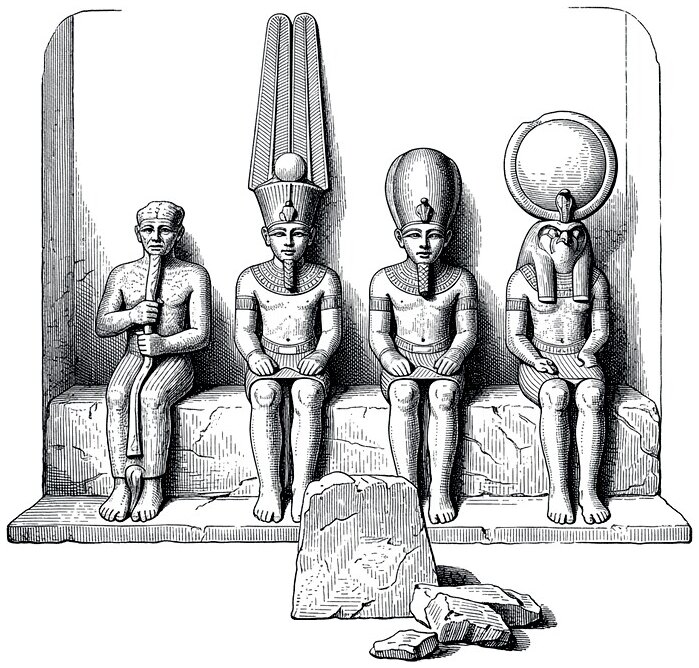
Around 2300 BCE, Egyptian masons carved funerary spells inside the pyramid of King Pepi I. The texts promised the dead ruler sacred incense from Dedwen, a god from Nubia, the southern borderland known as the land of archers. In the most sacred room of an Egyptian tomb, the royal scent came not from Egypt, but from a foreign neighbor.
Dedwen, whom older books also call Dedun, kept that title for a very long time. “Foremost of Bowland” stands in the Pyramid Texts, and nearly 1,700 years later a king of Kush, the Nubian kingdom that had grown up around the town of Napata, put the same words on his election stela, the inscribed stone slab on which he recorded how he had been chosen king. Between the two lie a fortress, a temple carried off to a museum, and a mountain where the god was said to live.
Appearance
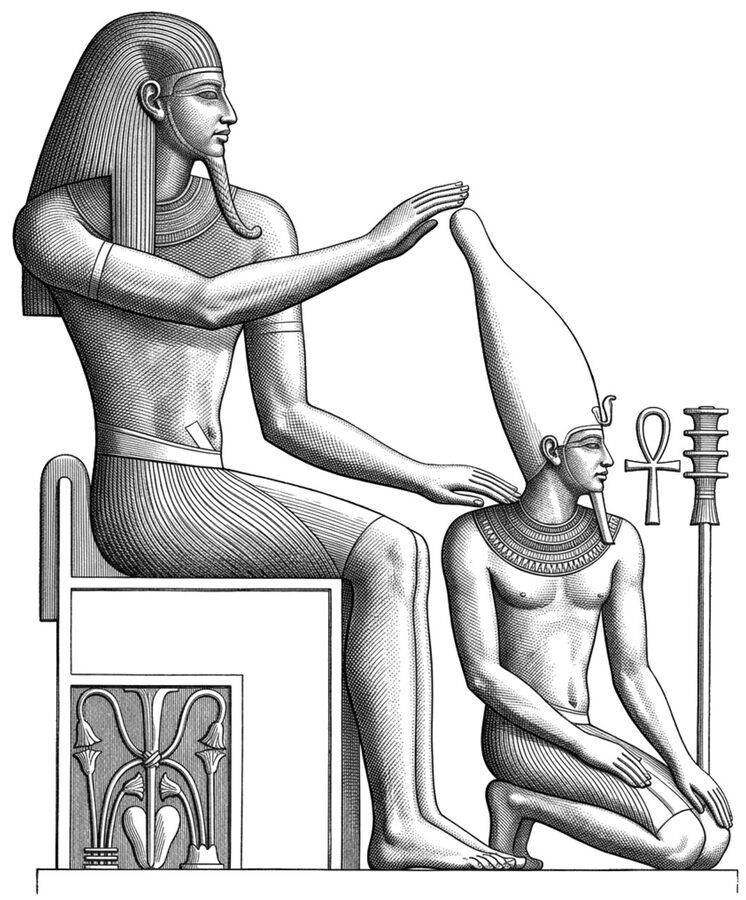
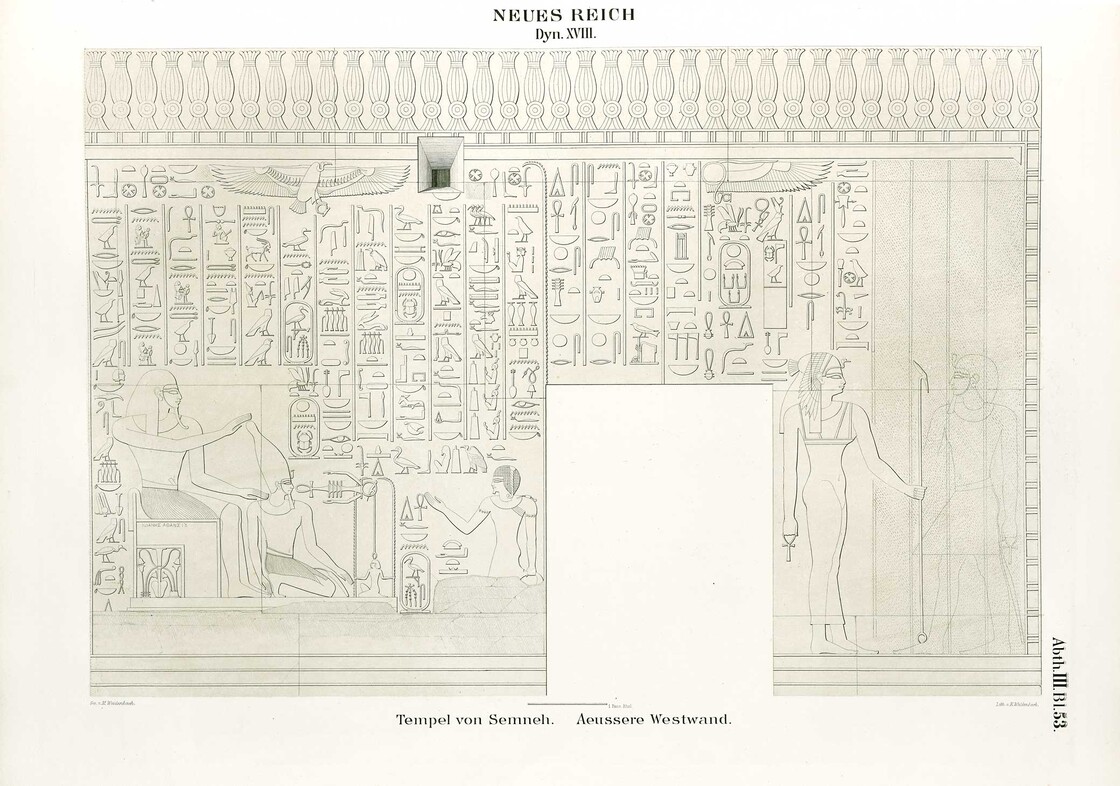
The clearest portrait of Dedwen survives from Semna, an ancient Egyptian river fort in northern Sudan. On a temple wall, the god sits on a simple block throne. He wears a divine beard and reaches out to crown King Thutmose III with the tall White Crown.
The pharaoh kneels facing away from the enthroned god, looking toward a priest who recites the ritual. Dedwen effectively crowns him from behind. The engraving above shows this scene as drawn by a Prussian expedition in the 1840s.
Surviving images of Dedwen are rare. Only one portrait made by Nubian artists is known: at Napata in Sudan, King Taharqo offers bread to the god. Early twentieth-century scholars noted that before his human form, ancient hieroglyphs often wrote his name using a bird perched on a curved branch.
Popular reference sites add a lion. Wikipedia says that “he was depicted as a lion”, and the Godchecker site says he “is depicted as a man or lion”, but neither names a carving or a text, and we could not find the ancient image behind the claim.
Function
In the earliest royal spells, Dedwen serves two clear roles. He supplies fragrant incense, and the dead pharaoh merges with him. Multiple spells promise the king the god’s clean scent for his ascent to the sky. Other lines declare outright: “Pepi is Dedwen, foremost of Bowland.” Why an outside Nubian god provided the holy incense of Egypt remains an unsolved mystery.
The second great chapter of his story begins with conquest. Around 1860 BCE the Twelfth Dynasty king Senusret III, whom older books call Sesostris III, built a fortress at Semna during his wars in Nubia. Its temple, according to the American Egyptologist James Henry Breasted, was sacred to Dedwen and to Khnum, a ram-headed Egyptian god. Senusret III fixed the offerings the temple was to receive, and in time he was worshipped there himself as the hero who had conquered Nubia. Breasted noted that the earliest evidence for this worship of Senusret is the later stone temple of Thutmose III.
Four centuries later, Thutmose III rebuilt the crumbling brick shrine in fine local stone. He dedicated the new temple both to Dedwen and to the deified Senusret III. His decree restored seasonal deliveries of grain and sacrificial bulls for the god.
Inside, a carved relief shows Dedwen embracing the new pharaoh. The god speaks warmly of the ancient conqueror whose shrine was restored, calling both kings his beloved sons.
At Semna, the Nubian deity legitimised Egyptian dominance. By crowning Thutmose, Dedwen handed over divine authority over southern lands. The same theme surfaced at Karnak in Thebes, where reliefs show Dedwen leading captured towns toward the king.
Dedwen also oversaw southern trade. In Queen Hatshepsut’s temple reliefs at Deir el-Bahari, expedition ships return laden with riches from the land of Punt. While workers weigh gold rings against cattle-shaped weights, Dedwen stands beside Horus to watch over the scales.
Cross-Cultural Connections
In the eighth century BCE the balance of power turned. The kings of Kush, ruling from Napata near the Fourth Cataract, conquered Egypt and ruled it as its Twenty-fifth Dynasty. They worshipped Egyptian gods, above all Amun, whom Aspelta’s stela calls the god “who is upon Pure-mountain”, the mountain Jebel Barkal beside their capital, and they also took over the god whom the Egyptians had made the lord of Nubia. According to Fontes Historiae Nubiorum, Taharqo, one of these kings, restored the temple at Semna, and the cult of Dedwen appears to have been carried from Semna to Napata in his time.
Around 640 BCE, Nubian kings built a stone sanctuary at the base of the sacred mountain Jebel Barkal. Although dedicated to Amun, its inner shrine held a long text to Osiris, the lord of the dead. In these lines, Osiris appears linked directly to Dedwen.
Excavators also found bronze figurines and a carved false door like those in royal tombs. The entire sanctuary functioned like a royal mortuary chapel.
Kendall’s reading of the temple goes further. He suggests that when a king died, the sacred boat of Amun of Napata was carried from the main temple into B 700, as if the sun god had set and gone into the underworld, and that “inside the temple, in other words, Amun-Re was transformed into Osiris-Dedwen” (Amun-Re is Amun joined with Re, the sun god). When a new king was chosen and crowned, the god returned to his own temple as Amun, and the new king took his throne. A colossal statue of Atum, the god of the setting sun, stood at the temple door, which supports the reading but does not prove it. No Kushite text describes this ritual, and Kendall offers it as a theory.
The Semna crowning scene echoed across centuries. At Kawa, King Taharqo mirrored the exact kneeling pose of Thutmose III before his own gods. Elsewhere at Thebes, Dedwen appears alongside Sobek, the crocodile deity, granting rule over distant southern frontiers.
Modern Survival
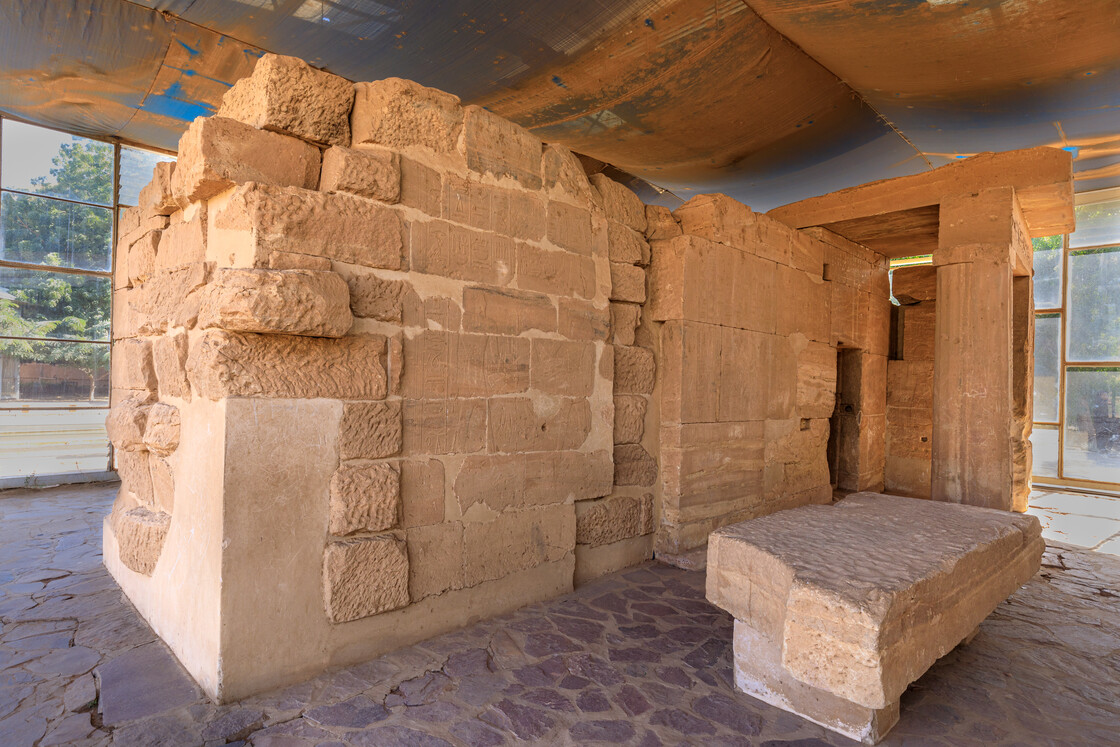
The temple at Semna no longer stands at Semna. In the 1960s, before the reservoir of the Aswan High Dam covered the fortress, the temple of Thutmose III was taken apart stone by stone and rebuilt at the Sudan National Museum in Khartoum. The fortress of Semna and its twin Kumma across the river now lie under Lake Nubia, the Sudanese part of Lake Nasser.
Modern websites often label Dedwen a god of wealth and prosperity. Ancient inscriptions say nothing of the kind. They treat him as an incense bringer, a border guardian, and an affirmer of royal authority.
Other websites claim that King Aspelta made Dedwen his supreme deity around 600 BCE. Aspelta’s own memorial tells a different story. When leaders gathered to choose a new ruler at Jebel Barkal, the supreme god Amun made the choice. Dedwen appears only as the traditional spirit residing within the mountain.
Why the stela names Dedwen at the moment the throne stood empty, the stone does not say. It does show that a Kushite scribe in the sixth century BCE still knew the title that Pepi I’s masons had carved at Saqqara: Dedwen, foremost of Bowland, a god of Kush.