On Sunday, 4 August 1577, a sudden violent storm struck the English market town of Bungay. The townspeople were gathered inside St Mary’s church for morning prayer. Lightning flashed and thunder shook the building, plunging the interior into near-total darkness. Then, according to an early report, a terrifying shape appeared: a black dog tearing down the aisle. It dashed between two kneeling parishioners and wrung their necks backwards, killing them instantly.
This account forms the earliest written record of Black Shuck, the legendary phantom hound of East Anglia. Surprisingly, that original 1577 report never mentions the name Shuck at all.
The pamphlet of 1577
The story comes from a short booklet printed in London that same year, titled A straunge and terrible Wunder. Its author was Abraham Fleming, a London writer and later clergyman. Fleming never claimed to have witnessed the disaster himself. He worked from written reports sent to him from Suffolk, compiling accounts from local witnesses.
Fleming adds more details about Bungay. The dog gripped another man by the back, leaving him scorched like shrivelled leather, though he survived. A clap of thunder knocked down the parish caretaker outside. Inside, the rector led the panicked congregation in prayer. As physical proof, Fleming pointed to claw marks in the church door and stones, alongside a shattered church clock.
The pamphlet then turns to Blythburgh, a coastal village seven miles away. On the very same morning, the black shape reportedly entered Holy Trinity church there. It perched on the rood beam, the high wooden beam where a crucifix had once hung. The creature then leaped down, killing two men and a boy while burning another person’s hand. It then vanished out of the building in a flash.
Appearance
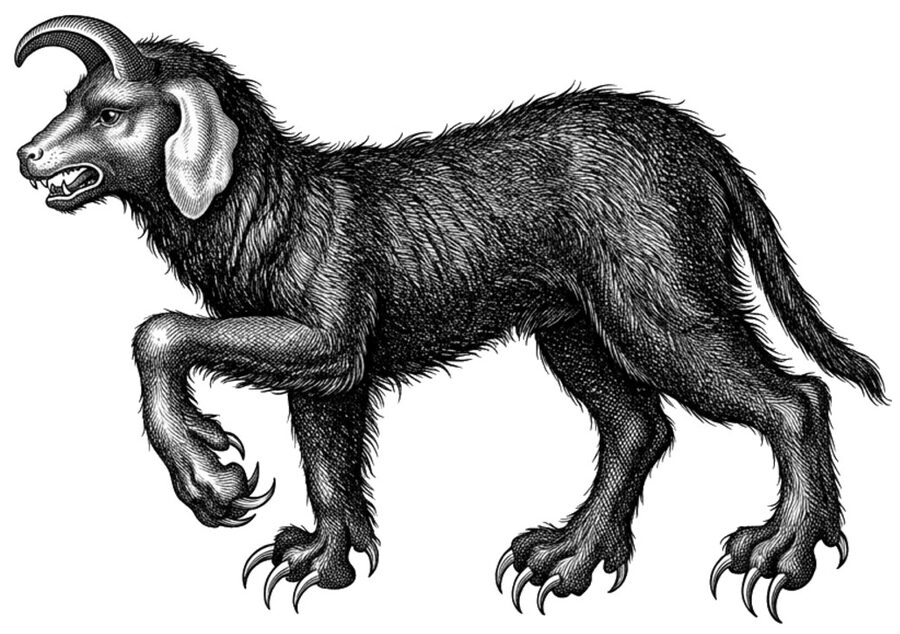
In 1577 the creature had few detailed features. Fleming merely called it a black dog or “an horrible shaped thing”. Above his title page sat a woodcut showing a black dog with long claws and a curved horn rising from its head. The engraving above shows this historic design.
The familiar modern folklore of Black Shuck only emerged in Victorian Norfolk. In May 1850, a local clergyman wrote to the journal Notes and Queries about a regional phantom: “a black shaggy dog, with fiery eyes, and of immense size, and who visits churchyards at midnight”. One terrified witness later found scorched ground where the dog had vanished. A coastal path near Overstrand became known locally as Shuck’s Lane.
In 1901, travel writer William A. Dutt established the modern legend in Highways and Byways in East Anglia. He described Shuck as a silent, prowling hound whose eerie howl chilled the blood. Dutt added a striking new detail: a single glowing eye in the centre of its forehead, like a Cyclops. Local fishermen told him that stormy nights were Shuck’s favourite weather.
Function
For Fleming, the dog served as divine judgment. He interpreted the storm as a call to national repentance. As to the beast’s true nature, he hesitated, calling it “this black dog, or the divel in such a likenesse”. The pamphlet concluded with a Latin plea for protection: deliver us from all evil.
By Dutt’s time the dog had a different task: it warned one person at a time. To meet him, Dutt wrote, “is to be warned that your death will occur before the end of the year”. His advice was to shut your eyes whenever you heard the howling, “even if you are uncertain whether it is the dog fiend or the voice of the wind you hear”.
The name Shuck has two likely origins. Victorian folklorists suggested the local dialect word shucky, meaning shaggy. Linguists instead point to the Old English noun scucca, meaning a demon or devil. Both explanations fit the creature’s menacing reputation, though neither appeared in the 1577 account.
Cross-Cultural Connections
Stories of phantom black dogs are told in many parts of Britain, and the men who wrote Shuck down compared him with the others. Dutt called him “the ‘Moddey Dhoo’ of the Norfolk coast”: Moddey Dhoo is the name, in the old Manx language of the Isle of Man in the Irish Sea, for the black dog said to haunt that island. Dutt also mentioned, without agreeing, that some scholars saw in Shuck an old Scandinavian story of the black hound of Odin, the chief god of Norse mythology, brought to Norfolk by the Vikings who settled on its coast. E.S.T. had asked a similar question in 1850, when he wondered whether Shuck was a trace of a German “dog-fiend”.
In Wales, the ghostly hounds of the otherworld, the Cŵn Annwn, were still taken in the nineteenth century as a sign that someone nearby would die, much as Dutt describes for Shuck in Norfolk. And the belief that the devil could take a dog’s shape was common in Fleming’s own century. At the trial of the Pendle witches in Lancashire in 1612, witnesses spoke of a black or brown dog with fiery eyes called Ball, which they took for a familiar, a spirit in animal form that served a witch, as told in Pendle Witch Executions (1612). In the Swiss city of Basel, a man told the magistrates that he had seen something like a black dog on the road at night just before the devil seized him, a case told in The City That Barely Burned.
Modern Survival
Historical records confirm that a devastating lightning strike did occur that morning. Blythburgh church annals record lightning shattering the church doors, damaging the steeple, and killing two parishioners. Across in Bungay, parish accounts similarly register two men killed in the belfry. Crucially, neither official parish record mentions any dog at all.
Today, visitors can still see scorch marks on a church door, but at a different location. Fleming placed the claw marks in Bungay. Yet the burns shown to tourists today mark the north door of Holy Trinity church in Blythburgh. Known locally as the devil’s fingerprints, they may be lightning burns or candle scorches. Somewhere over the centuries, the legend drifted seven miles eastward.
Bungay kept the dog. When the town received its coat of arms in 1953, the crest at the top showed the Black Dog of Bungay running along a red flash of lightning, and the arms passed to the new Bungay Town Council in 1974. On 4 August 2022, the anniversary of the storm, the town held its first Black Shuck Festival, and the dog that Fleming saw as a sign of God’s judgment now runs on lightning above the name of the town that buried two of its men after that Sunday morning.