In a village in Bengal, a young wife from a priestly Brahman family went out one night to the village pond. A tree stood on the bank, and in the tree lived a female ghost. The wife brushed against the ghost in the dark. Angry at the touch, the ghost seized her throat, dragged her up the tree, and shoved her into a hollow trunk. Then the ghost put on the woman’s clothes and walked into the house in her place.
For days neither the husband nor his mother noticed anything wrong. The wife simply finished her chores unusually fast. Then the mother-in-law saw her stretch an arm across several yards to reach a pot. Later she found her cooking with no firewood at all, using her own blazing foot in the oven.
The family sent for an ojha, a traditional exorcist. He lit a piece of turmeric and held it under the young woman’s nose. She screamed and ran from the room. When the exorcist beat her with his slippers, she confessed in a nasal voice who she was and where she had hidden the wife. The real wife was rescued from the tree hollow and slowly recovered.
The Bengali writer Lal Behari Day heard this tale told in Bengali by one of the old storytellers he sought out, and printed it in English in 1883 as “A Ghostly Wife”. Each strange detail pointed to a known sign. Across northern India and Bengal, people believed they could identify this spirit: the bhut, the restless dead.
Appearance
Bhut (in Hindi usually spelled bhoot) comes from bhūta in Sanskrit, the old sacred language of India. The folklorist William Crooke, a British official who collected the beliefs of northern India in the 1890s, translated it as “formed” or “created”. Early Hindu writings used the word for nature powers and even gods. The great god Shiva still carried the title Bhūteśvara, ’lord of spirits’. Over time the word narrowed to mean an evil ghost.
Crooke’s The Popular Religion and Folk-Lore of Northern India (1896) gives three tests for spotting a bhut that has taken human shape. The first is that it casts no shadow. The second is its terror of burning turmeric, a spice root used in village rites to repel demons. The third is that a true bhut always speaks with a nasal twang. Among his sources for these signs Crooke cites Day’s collection, where the narrator of the ghostly wife’s story adds that “all ghosts speak through the nose”.
A bhut also never sits on the ground. Crooke explained that the earth, worshipped as a goddess, drives away every evil influence. So at the small shrines of the castes ranked lowest in Hindu society, people set up a couple of pegs or bricks, or hung a bamboo pole, for a visiting bhut to perch on.
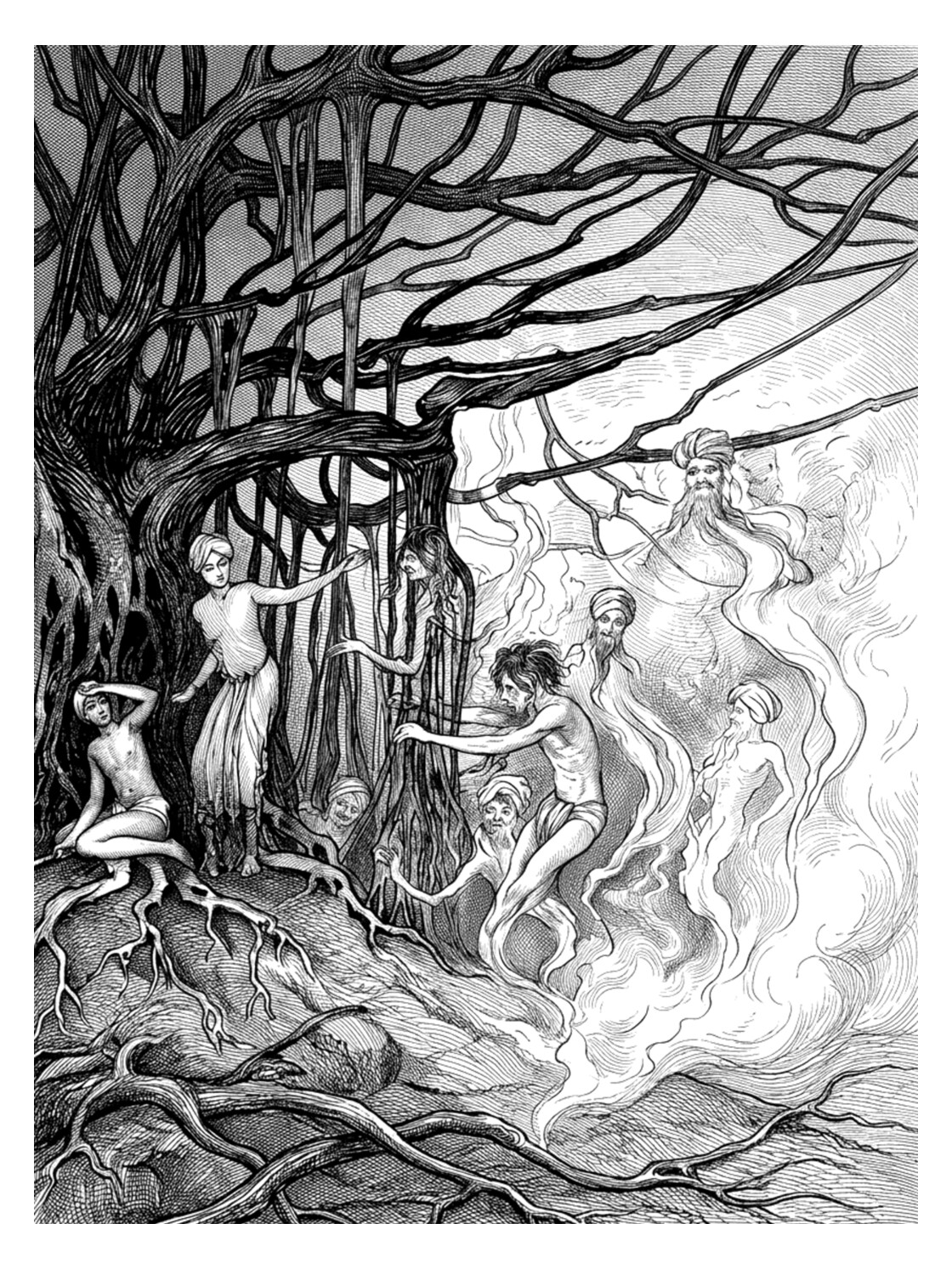
For Bengal, Crooke drew on Day’s novel of village life, Govinda Samanta. There the ordinary bhut is as tall as a palm tree, thin and very black, and always naked. It lives in trees and wanders the fields at night, above all at midnight, frightening travellers. Bengali bhuts ate normal food but loved fish best. According to Crooke, villagers refused to speak of fish at night for fear of luring one.
The engraving above follows a 1912 illustration by Warwick Goble for Day’s tales. It shows spirits from a banyan tree rushing at a poor Brahman who tried to cut a branch at night. A banyan is a wide fig tree whose aerial roots drop down to form extra trunks.
Function
Crooke described the “proper” bhut as the spirit of a man who had died a violent death, by accident, suicide or execution. If such a man was also denied his funeral rites, he became even more malignant, because the rites were what the dead needed to find rest. Thirteen years earlier the Sanskrit scholar Monier Monier-Williams had given almost the same definition in Religious Thought and Life in India (1883), as the view of “some authorities”. A. Berriedale Keith repeated it in 1917 in The Mythology of All Races, so the description passed from book to book.
The bhut was most dangerous to women and children, and to anyone at a turning point in life, such as a wedding or a birth. It could also attack people who had just eaten sweets. A sweet-seller who supplied a school treat once brought salt along, telling each boy to take a pinch to clear the sweetness. Salt repels spirits. Bhuts also crave milk. In the Punjab, a mother would not let her child outdoors after drinking fresh milk without putting salt or ashes on its tongue.
A bhut could enter the body through the mouth. Anyone who yawned was in danger, because a bhut might slip down the throat. So the person yawning covered his mouth and said “Narayan”, a name of God, or cracked his fingers to scare the spirit away. Monier-Williams recorded the same popular belief: a demon could dart into a man who yawned “without holding his hand or snapping his fingers before his face” and live inside him.
Bhuts gathered at cremation grounds, deserts, crossroads, and village boundaries. They also moved into houses left empty. The old fort of Agori on the Son river was abandoned because of them. In Mirzapur, a merchant built a grand town house and had to flee it for the same reason.
They also guarded buried treasure. In the plains of Uttar Pradesh, a farmer dug up a hoard in an ancient fort. He gave much of it to charity to escape bad luck, but he still died a beggar. Local villagers blamed the bhuts that guarded the gold.
There was help against them. Lying on the bare ground was safe, because bhuts cannot touch it, and that is why a bride and bridegroom rested on the ground, and why a dying man was laid on the ground at the moment of death. A person beset by bhuts in Bengal was told to call on the fierce warrior goddesses Kali and Durga, and above all on Shiva, because Shiva, as Crooke reminded his readers, is the lord of the bhuts.
Cross-Cultural Connections
Bhut is also the umbrella word for a whole family of Indian ghosts, and Crooke sorted them by the way they died. The churel is the ghost of a woman who died pregnant or in childbirth, and she gives herself away by her feet, which are turned backwards. The vetala is a spirit that enters a corpse and makes it move, and Crooke called it the leader of the bhuts. A third name, pret, means ‘departed’. It is the soul of any dead person before the funeral rites end. Believed to be no larger than a thumb, it wanders its old home until offerings transform it into an ancestor.
Monier-Williams, who had made his own inquiries about these spirits, warned that the neat division into kinds was “nowhere universally accepted” and “never consistently maintained”. In his experience, people used bhut and pret for all ghosts alike.
Crooke compared Indian lore with European traditions. For the missing shadow, he pointed to Dante’s Purgatorio, where the spirit Virgil casts no shadow. For crossroads spirits, he cited the old English custom of staking suicides at crossroads. Crooke called such ideas the common property of folklore. Whether they go back to one old belief or arose again and again from the same fear of the dead, his comparisons leave open.
In Benares, the holy city on the Ganges now called Varanasi, the guardian god Bhairon was worshipped as Bhut Bhairon, “Ghost Bhairon”. There he kept order in the city like a chief of police and saved his followers from demons, and in the villages he was given offerings when a new house was built so that he would drive out the local ghosts.
Modern Survival
The word is still in everyday use. In Hindustani, the everyday language shared by Hindi and Urdu speakers, a neglected building can be called a bhoot bangla, a “ghost bungalow”, and a person with an obsession can be said to be ridden by its bhoot. Ghost stories hold a large place in the culture of Bengal, among both Hindus and Muslims. In 2003 the director Ram Gopal Varma released Bhoot, a Hindi horror film starring Ajay Devgn and Urmila Matondkar, and a sequel, Bhoot Returns, followed in 2012.
Crooke ended one of his treasure stories with a scene from his own court. An old man came in to hand over two old brass pots that he had found while ploughing a year before. Since then trouble had followed trouble, and his son, who had been with him when he found them, had died. Local sorcerers urged him to surrender the find. He brought the pots to the magistrate, hoping the British government had a protective spell strong enough to survive the curse.