In northern India, the fiercest protector of fields and cattle was also a city’s chief of police. In the villages, people knew him as Bhairon and won his favor by feeding black dogs. In the sacred city of Varanasi, worshippers called him Bhaironath, or “Lord Bhairon.” There, only his temple welcomed dogs through the gates. Sweet-sellers sold sugar figurines of dogs as offerings, and the city treated the god as its divine magistrate.
In the 1890s, the folklorist William Crooke gave Bhairon a surprising history. He argued that the terrifying god who kept order in the holy city of Shiva had started out as a simple village guardian.
The god goes by several names, and they all point to the same figure. Bhairon is the everyday name in the villages of the north. Bhairava, “the terrible one”, is the Sanskrit name used in the temples and the old texts. Bhaironath means “Lord Bhairon”, and in Bombay and western India he was called Bhairoba.
Appearance
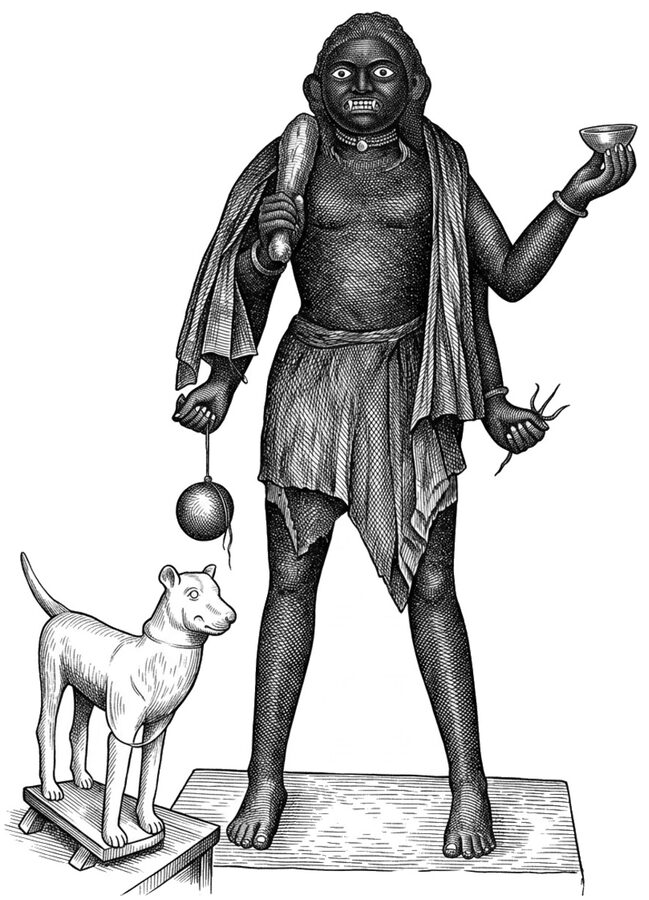
The engraving on this page follows a nineteenth-century photograph from a shrine in northern India. A dark figure stands barefoot on a low pedestal with a club over his shoulder, a cloth around his shoulders, and a short kilt. He holds up a small bowl, while a pale wooden dog stands on a separate block beside him. Later scholars read the vessel as a bowl of blood.
Most of the time, Bhairon had no human shape at all. Across northern India, a plain stone smeared with oil and red lead stood for him beside the images of greater gods. Further west, villagers pictured him as a stout dark figure carrying a bottle of liquor.
His grander form, Kal Bhairon or Kala Bhairava (“Black” or “Time” Bhairava), was carved with his dog as a warden in temples of Shiva. One temple image had eighteen arms, garlands of skulls, and snakes for jewelry. The main temple image in Varanasi had four arms, a stone body, and a face of beaten silver.
Function
In the villages, farmers worshipped Bhairon with milk and sweets to protect fields and cattle. When someone built a new house, they made offerings so he would drive away wandering spirits. The surest way to please him was to feed a black dog until it could eat no more. Villagers also fed bread marked with protective numbers to black dogs to bless childless families.
In western India, where he was called Bhairoba, the god also served as an oracle. A petitioner stuck two betel nuts to the statue’s chest, asking the god to drop the right or left nut to signal yes or no. Local belief said Bhairoba rode through the night on a black horse with a hound at his side. Further north in Rajasthan, chroniclers described him more harshly as a god of war.
Crooke saw a clear career path in these shrines. Village deities often served as doorkeepers along pilgrim roads. A stone guardian at the base of a sacred hill stood at the entrance, marking a village god halfway toward acceptance in the grand temples.
Varanasi showed the final stage of that rise. The city treated Shiva as its supreme king. Shiva ruled everyone inside the circular fifty-mile pilgrim road that bounds the holy ground. Yet he gave his everyday commands through Bhaironath, who acted as his chief of police.
Minor deities along the boundary road reported directly to him. Bhaironath had to banish malicious spirits and wrongdoers. At his central shrine, priests waved wands of peacock feathers over worshippers to brush away bad luck, and visitors offered cups of liquor to the altar.
Cross-Cultural Connections
Crooke argued that priests absorbed the village god under a slightly modified Sanskrit name: Bhairava, meaning “the terrible one.” His main clue was the dog. As a form of Shiva, Bhairava bore the title Śvāśva, meaning “he whose horse is a dog.” Folklorists saw this canine mount as proof that a rural spirit had entered the formal pantheon.
The Sanskrit tradition tells the story from the other end. In the Śiva Purāṇa, one of the long Sanskrit books of myth called Puranas, the creator god Brahma, who in this story has five heads, speaks to Shiva with contempt and calls himself Shiva’s maker. Shiva in anger creates a being “blazing in great brilliance” and names him Kalabhairava, the one of whom even Kala, Time or Death, is afraid. Before sending him out, Shiva grants him rule over Kashi, the old name of Varanasi, “the city of liberation”, and makes him “the chastiser of those who commit sins there”.
Bhairava severs Brahma’s fifth head with his fingernail. Because slaying a creator is a grave sin, the skull sticks fast to Bhairava’s hand. He must wander the earth as a penniless beggar. Only when he steps into Varanasi does the severed skull drop from his fingers, freeing him from the guilt. In this sacred account, Bhairava arrives in the city not as an elevated field god, but as an aspect of Shiva.
The two accounts agree on the office and differ on the direction. Crooke watched a field god climb toward the great temples, and the Purana sends a high god down into a city. Crooke himself noticed how mixed the picture already was in his day. The Jains, followers of Jainism, an old Indian religion of its own, worshipped Bhairava as protector of their community with fruit and sweets instead of blood offerings, and Muslims honoured Bhairon as the minister of Sakhi Sarwar, a Muslim saint of the Punjab.
Other popular figures filled similar roles. Shrines to Hanuman stood guard along mountain paths before pilgrims reached higher shrines, and Ganesha guarded entrance gates. Rural earth gods often shared altars with Bhairon as wardens of the soil.
Modern Survival
Crooke counted his worshippers in the census returns he had: 175,000 in the North-Western Provinces, the province that included Benares, and only 5,000 in the Punjab. Today the god is best known under his Sanskrit name. The temple of Kaal Bhairav in Varanasi stands in a neighbourhood that carries his name, Bharonath. Wikipedia’s account of it describes a silver-faced image seated on a dog and holding a trident, of which visitors see only the face; the rest is covered with cloth. Modern guidebooks still call him the police chief of Varanasi. Tradition asks pilgrims to visit his shrine after visiting Shiva’s main temple, ensuring the city warden inspects every visitor who arrives.
At the Kal Bhairav temple in Ujjain, in central India, the liquor offering Sherring saw in Benares has become the centre of the cult. According to Wikipedia’s account of the temple, the priest holds a saucer of liquor to the god’s lips and hands part of it back to the worshipper, and in 2015 the state government set up liquor counters outside the temple. The festival of Bhairava Ashtami marks the day Kala Bhairava appeared on earth.
Whether the dog-rider rose from village fields or descended from Sanskrit scripture remains unsettled. An older clue survived outside the temple walls in Varanasi: beside the grand shrine stood a small, weathered stone figure of Bhaironath, likely the original village idol preserved when the grand temple was built around it.