In nineteenth-century Armenia, women gave birth surrounded by iron blades. Outside the house, a relative rushed to the nearest stream to beat the water with sticks. They were fighting the Al, a childbirth demon feared across Armenia and Iran. The demon’s plural form is Alk. Its clearest portrait survives in a protective prayer recorded as a roadside encounter.
In the charm, Christian apostles meet a strange figure sitting in the sand. The creature has snake-like hair, brass eyebrows, glass eyes, iron teeth, and a boar’s tusk. When questioned, it calls itself the wicked Al. It confesses that it sits on labouring mothers, scorches their ears, rips out their liver, and strangles both mother and infant.
The text reached English readers in 1925 through the scholar Mardiros Ananikian. In his study of Armenian myth, he called the Alk the most gruesome tribe among all traditional demons.
Appearance
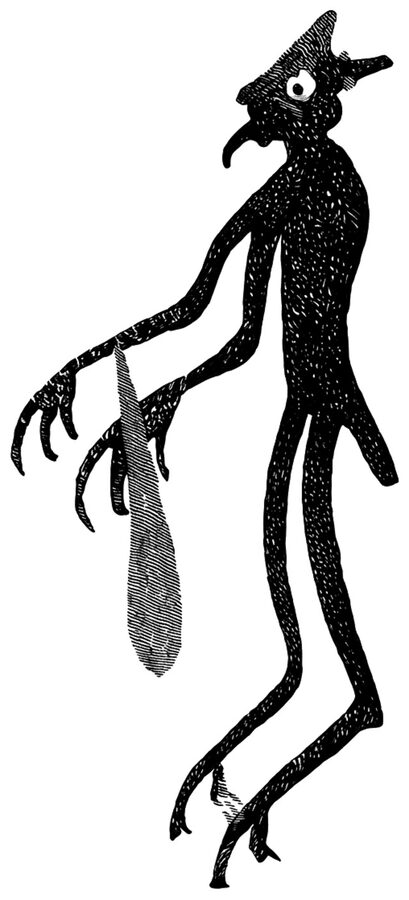
Nineteenth-century folklore collections describe the creature as half animal and half human. It is shaggy and bristly, with a fiery eye, copper claws, iron teeth, and tusks like a wild boar. In some accounts, it grips an iron chopping knife. In others, it carries heavy iron scissors.
Villagers spoke of them as a separate race with males, females, and children. Charms mention a demon mother who directs them. They also serve an underworld king trapped in an abyss, held down by heavy chains or submerged in molten lead.
The illustration above comes from an 1895 Armenian woodcut published in Venice. It shows a gaunt, long-limbed figure with a bird-like beak and curved claws. From one hand hangs a tapered object. While the original caption does not explain the object, folk charms suggest it represents the mother’s stolen liver.
Function
The demons dwelled outside human settlements, haunting mountains, roadsides, and damp wetlands. Medieval Armenian commentaries noted their fondness for murky water. From these wild margins, they slipped into homes to hide in stables, shadowy corners, or roof rafters.
During labour, the Al allegedly pressed onto the woman’s chest, devoured the unborn infant’s flesh, and snatched the mother’s liver. In folklore, the demon consumed newborn flesh and maternal blood. It preyed especially on fetuses in the seventh month of pregnancy, carrying them down to its chained king.
One Armenian legend explains this hostility through a creation myth. God originally shaped an Al from fire to be Adam’s first mate. Because Adam was made of clay, the pairing failed, and God created Eve instead. Spurned and resentful, the Al became the sworn enemy of Eve’s daughters, cursed to stalk weddings and ruin childbirth.
To safeguard childbirth, households deployed metal and noise. Relatives slipped a dagger beneath the mother’s pillow and ringed the bed with iron agricultural tools, as iron was believed to repel evil spirits. Family members slashed the air of the room to hit invisible intruders. Outside, others thrashed the local stream to prevent the demon from washing the stolen liver. A priest’s mantle was draped over the mother while holy names were chanted.
A mother fainting after delivery was seen as proof of the demon’s presence. In severe cases, villagers placed the newborn on the flat roof of the house as an offering, hoping the spirit would claim the infant and spare the mother. Ethnographers viewed this ritual as the last survival of an ancient practice of appeasing the demon with sacrifices.
Cross-Cultural Connections
Linguists and historians have linked the Armenian Al to Persian folklore and the ancient Mesopotamian alu, a Sumerian and Babylonian evil spirit. While textual records of the Al emerge only in medieval Armenian manuscripts, oral traditions likely carried the concept across cultures for centuries.
In Iranian tradition, the Al appears as a haggard crone with a clay nose and a flushed face, bearing a reed basket to carry off maternal lungs and livers. Across Central Asia, the belief expands into the Turkic Albasty. She shares the same habits: seizing vital organs, sprinting toward water, and retreating from cold iron.
The Al belongs to a wider family of childbirth horrors. It closely mirrors Lilith, the Jewish night demon remembered in medieval folklore as Adam’s discarded first bride. It also shares traits with the Greek Lamia, who preyed on human infants out of vengeance.
Christian protective charms pitted warrior saints against the creature. In one tale, saints hunt down the Al, bind it to a sacred stone, and interrogate its mother. A similar formula appears in late antique lore, where the child-strangler Obyzouth was expelled by invoking angelic names on written amulets.
Folklore also recorded a companion demon named Thepla. It suffocated mothers and caused newborns to turn black and perish, depicted in church woodcuts as a shaggy, horned beast.
Modern Survival
Through the early twentieth century, these rituals persisted across rural villages. Over time, some of the Al’s predatory role blended with stories of Devs, monstrous giants who stole babies and left withered changelings in their place.
Whether driven off with iron or challenged at the riverbank, the Al embodied ancient anxieties over infant mortality and maternal fever, giving tangible shape to dangers that early medicine could not explain.