


Pluckley’s ghosts make up some of England’s best-known folklore, and most of the tales came out of one man’s notebooks. Frederick Sanders grew up in the village, hunted its ghosts for decades, printed his own booklets about them, and in December 1950 wrote the newspaper article that first called Pluckley the most haunted village in England. Ten of the stories still in circulation trace back to what he put on paper.
Sanders’ list runs from a highwayman to a miller who walks before a storm, and it includes a man who screamed in the clay pit, a hanging in a lane and a suicide in the park wood. Two ladies, one red and one white, are said to keep to St Nicholas’ churchyard. Taken together they turned a farming parish of about a thousand people into the village that tourists now visit in October.
Simon Moreton, a researcher at the University of the West of England, set out to trace where the stories came from. He went through newspapers, parish papers and birth, marriage and death records, and published the findings in the journal Folklore in 2025. His subject was the writing rather than the sightings, and what he found was that some of the ghosts sit on top of real deaths while others came out of a magazine commission.
The ghosts are older than the reputation. Sanders gave the village its “most haunted” label in December 1950, but the earliest written trace Moreton found of any Pluckley ghost is a newspaper report from 24 July 1939, when Sanders was out hunting the Red Lady of St Nicholas’ Church for the Daily Herald. Before that date, the paper trail is empty.
Pluckley Village Ghosts: Where Does the List Come From?
Sanders was born in the village in 1908, the son of an RAF sergeant, and came back to it as a boy in 1919 while his father was posted to Uxbridge. He was an amateur local historian with a taste for psychical research, and from the late 1930s he kept notes on everything he heard. That habit is the reason the village has a ghost tradition at all: he wrote the stories down while they were still village talk, which made him the source that every later writer went back to.
His own record of what he did survives in a typed booklet, Psychical Research: Haunted Kent, which he self-published in 1946 and which logs fourteen ghost hunts across the county between February 1939 and December 1940. Two years after that he wrote to the Kentish Express under the title “Ghosts Were Owls” to suggest that one of the county’s reported apparitions was a screech owl. Sanders was willing to take a ghost report apart in print when the evidence pointed at a bird.
The article that fixed the village’s name appeared in the Kentish Express in December 1950 under the headline “Operation Spooks?”. In it Sanders gave the reader ten entities: a highwayman, a woman who sold watercress, a miller, a hanged schoolmaster, a red lady, a white lady, a colonel, a man who screamed in the clay pit, the Lady of Rose Court, and a bush connected with summoning the devil. He collected all ten from other people. His grandparents were a source, and so was his old schoolteacher Henry Turff, and so were the neighbours who told him what they had heard. He then told each story a little differently every time he retold it, which is why the list never quite settles.

What Did Pluckley Look Like Before the Ghosts?
In 1900 a Kentish journalist named Charles Igglesden published the first volume of A Saunter Through Kent with Pen and Pencil, and Pluckley got six pages. His opening move was to ask what the village was famous for. The answer he heard was brickmaking, from the tall shafts and busy yards of the Pluckley Brick and Tile Works beside the railway, works that had been running since 1879.
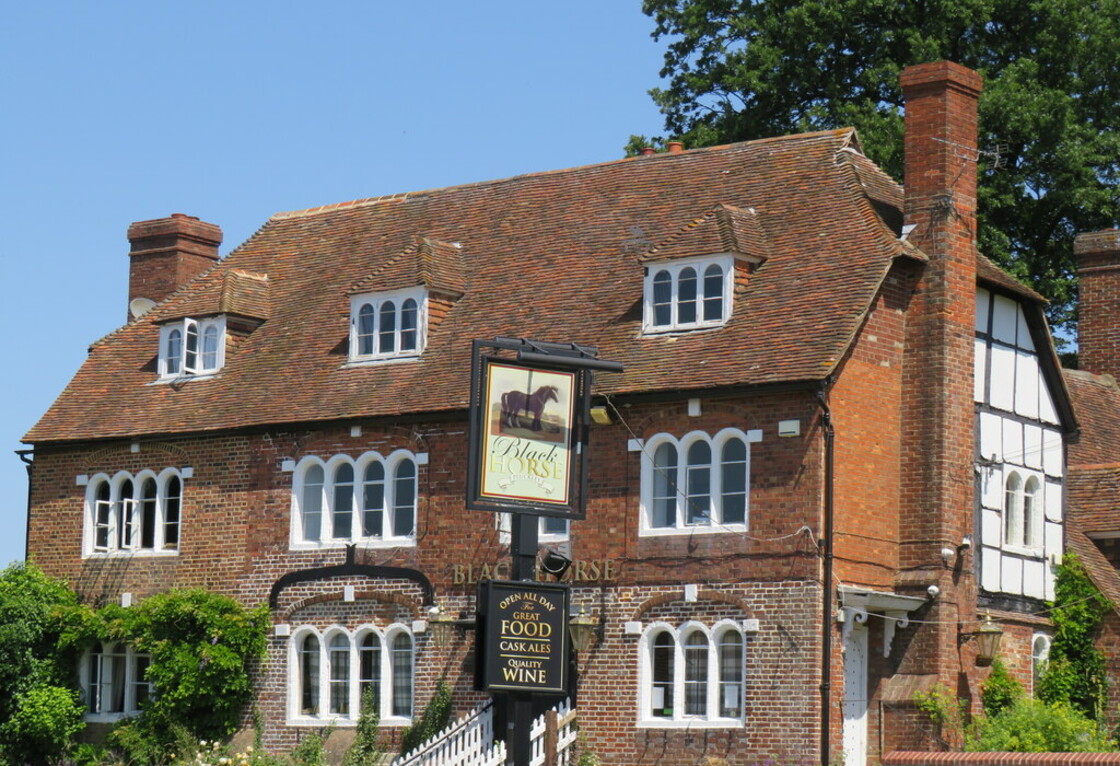
So he walked up the hill instead, into what he called one of the prettiest village scenes in Kent, and did the tour. The square struck him first, because the buildings around it had been dropped into odd corners on purpose. Then came the pub, the Black Horse, the only one the village had, once a farmhouse, with the original inn down among the cottages nearer the church. Inside the church he stopped at the Tudor and Jacobean screens, and outside he read the tombstones. One of them belonged to Jesse Spicer, “killed by a Ninepin Bowl, 20th of May, 1772, aged 22 years”, and Igglesden adds that the accident happened in the old Black Horse Inn.
So there is a violent death in a pub, in a village that would later be famous for ghosts, and the 1900 guidebook leaves it as a line on a stone. Igglesden was in the business of collecting oddities, and he walked past a perfect opening for a ghost story without touching it.
The chapter does contain one story that later Pluckley kept, and it is not about the dead. The semicircular-headed windows repeated on Surrenden and on cottages across the parish are there for a reason, and Igglesden gives it: a Dering escaped from the Roundheads during the Commonwealth by climbing out through one of those windows, and after that the shape became a family marker, kept in every building they put up. Nobody has to believe the escape happened for the windows to mean something. A family kept a story alive for two centuries by building it into its estate.
The Dering family held the manor from the fifteenth century until the estate was broken up in the 1920s. Their seat, Surrenden Dering, was besieged by Parliamentarian troops three times during the Civil War without being taken. It burned down in 1952, and the main house was demolished the following year. The wing that survives is a Grade II listed building.
Which of Pluckley’s Ghosts Were Real People?
Four of them, and the death certificates behind them were found in the records rather than in the stories.
Richard Bridgland was 35 when he was killed on Wednesday 11 January 1899. He was digging clay with two other men at the Pluckley Brick and Tile Works when part of the pit wall came down on him. He became the Screaming Man of the Clay Pit, heard in the area around the brickworks; the Paranormal Database, which logs local accounts, records the most recent report of screams there in 1991.
Sarah Sharp sold watercress and died on 10 August 1911, aged 76, after setting herself alight. She was probably lighting her pipe. A passer-by named John Maxted was reported as having gone on without helping her, and the jury returned a verdict of accidental death. She is the Watercress Woman, seen near the stream at the Pinnock, and she is a distant cousin of the researcher who identified her.
Mary Ann Bennett was 31 when she ended her life on 8 August 1862 by drinking opium. She became the Lady of Rose Court. Later tellings moved her back to Tudor times and gave her a love triangle, which is what a documented death from 1862 looks like after eighty years of retelling.
Henry Edgar Martin worked as a “coucher” at a paper mill near the village, one of the men who made sheets out of a vat of suspended fibre, and he lived at Jennings Farm. On 15 August 1919 he was found hanging by a halter from a tree. No newspaper reported it. What Moreton found instead was a marginal note in the burial register about a burial under a coroner’s warrant, which led back to the death certificate, and to an inquest that recorded felo de se, self-murder, rather than unsound mind. His widow Kate was still working at the Springfield Paper Mill twenty years later, aged 70.
Sanders took that death and put a schoolmaster’s life on top of it. He probably merged Henry Edgar Martin with Harry Martin, a teacher in the neighbouring village of Smarden who died in June 1923 and who, according to the Hartlepool Northern Daily Mail, was depressed at having to leave the village where all his friends lived to be treated in London. Harry Martin drowned in a pond in Smarden. The two men have been one ghost ever since.
Who Made Up the Other Stories?
The second man left a confession. Desmond Carrington was an actor living in Pluckley at the time. In 1962 he wrote a Christmas feature for the TV Times, and three of the ghosts in it were deliberate inventions.
Three of them went into the record: a phantom coach and horses, a monk at Greystones, and a poltergeist at Surrenden Dering. Carrington later admitted that he and the journalist Bill Evans had concocted the ghosts as an “angle” to make the article work. Pluckley absorbed all three anyway, and one of them has a kind of logic to it. Surrenden had burned down in 1952, ten years before the article, so the poltergeist was given to a house that was no longer there.
Invented ghost stories have a long history in England, and the famous ones did not always survive. The Cock Lane ghost of 1762 drew Samuel Johnson to a child’s bedroom at midnight to listen for a knock, ran for months, and ended in a courtroom with the fraud exposed and the perpetrators convicted. Carrington’s three ghosts were lighter work, and they are still on the village’s list.

From 1967 the village began appearing in paranormal books, and the books fed on each other. Each author took the previous list, kept it and added something: a poltergeist at Elvey Farm, a presence at the Black Horse. The count moved from ten towards twelve, then towards fourteen and sixteen, and none of that required anything new to happen in Pluckley.
What Did the 2025 Research Actually Change?
Nothing in the archives settles whether anybody has ever seen a figure in a churchyard, and Moreton’s paper does not try to. It reconstructs the writing of the stories instead, names the people who did the writing, and marks the point where a local tradition turns into a national brand. The eight documented English hauntings work the same ground from the opposite direction, taking court records and depositions first and asking afterwards which cases left anything behind.
Pluckley’s label is younger than the tourist industry that trades on it. “Most haunted village in England” is a sentence one man put in a local paper in 1950. And four of the ghosts are people with names, dates and causes of death recorded by a coroner, which means the stories grew out of the village from deaths that neighbours remembered, and then drifted away from them.
Moreton’s own family came from Pluckley, and he has said he was fascinated by the stories from childhood. In the university’s announcement of the paper he put the finding this way: “It’s been possible to demonstrate how one person with a passion for these kinds of stories was able to shape, for better or worse, the identity of a whole village through his storytelling.” He added: “It reminds us there are real people and real places behind these stories, both of which deserve our respect.”
Why Does the Label Still Hold?
What kept the label alive was print. The 1989 Guinness Book of Records mentioned Pluckley in the body of its text, and the passage has been quoted ever since:
Pluckley in Kent is generally thought to be the most haunted village in England boasting at least twelve spiritous inhabitants. These include both a White and a Red Lady at St Nicholas Church, a Highwayman at Fright Corner, a Screaming Man at the brickworks and a spectral Coach and Horses at various locations. Both pubs cater for more than one kind of spirit.
Guinness never made it a category. Even inside its own sentence the book is careful, writing that the village “is generally thought to be”. The researcher who went through all of this describes it as a mention rather than an award, and the popular retellings have been upgrading it into a title ever since.
Pluckley is not the only place whose reputation rests on a piece of paper. Borley Rectory in Essex was given the title of the most haunted house in England by a book Harry Price published in 1940, and the Society for Psychical Research spent eight years afterwards taking that book apart. Medveđa in Serbia owes its name to a report signed by Austrian military surgeons in January 1732, and the report survives in full. Pluckley’s founding document is a list one man wrote from village talk in 1950.
The 1990s did the rest. Pluckley was a filming location for the television adaptation of H. E. Bates’s The Darling Buds of May, and the audience that arrived for that found a village that had been sold as haunted since before they were born.
Dering Wood, two miles south-west of the village, shows what happens when a story outgrows the place that produced it. The Woodland Trust manages over 100 hectares of ancient semi-natural woodland there, keeping it as a free public wood. Its page runs through the trees, the wildlife and the history, and never once calls the place haunted. Ghost hunters call it the Screaming Woods. In 2017 the Trust said it had spent £41,000 on security and more than £6,000 on litter picks and replacing vandalised signs, and that staff were breaking up camps left behind by overnight visitors. The site manager, Clive Steward, put the whole thing in one line: “Dering has always attracted ghost hunters due to the noises that come out of the woods but the screams they hear are nothing more than amorous foxes.”

Moreton’s trail ends in a burial register, in a marginal note about a man buried on a coroner’s warrant in August 1919. That note is how a papermaker with a widow and a job at the mill turned into a schoolmaster hanging in a lane. The schoolmaster is on the village website and in the Guinness Book of Records. Henry Edgar Martin is in the margin, and on the death certificate, and nowhere else.
Sources
- Simon Moreton, ‘Laying Pluckley’s Ghosts: Frederick Sanders and the Origins of the “Most Haunted Village in England”, 1939-79’, Folklore 136, no. 1 (2025): 39-61, doi:10.1080/0015587X.2024.2425199. Open access, CC BY 4.0. The article is the source for the 1939 Daily Herald ghost hunt, Sanders’ 1946 booklet and 1948 letter, the ten ghosts of the 1950 Kentish Express piece, the identifications of Sarah Sharp, Mary Ann Bennett, Richard Bridgland and Henry Edgar Martin, the conflation of Martin with Harry Martin of Smarden, and Carrington’s 1962 TV Times fabrications. The publisher blocks automated access to the full text, so the findings above come from the author’s own published summary of the paper and from the reporting listed below.
- Simon Moreton, public summary thread of the Folklore article, read via threadreaderapp.com, thread 1738282695640203686 (consulted 19 September 2026). Carries the dates of the 1899 and 1911 deaths as they appear in the local press, the felo de se inquest verdict on Henry Edgar Martin, the burial-register note about a coroner’s warrant, and the detail that Sarah Sharp was the author’s distant cousin.
- University of the West of England, ‘Laying Pluckley’s ghosts to rest: new research uncovers the truth about the most haunted village in England’, press release, 24 April 2025, uwe.ac.uk. Names the ten ghosts of the 1950 list, and states that the 1989 Guinness Book of World Records mention was not an award.
- Craig Buchan, ‘Pluckley hauntings researcher is “distant cousin” of Kent ghost’, BBC News, 28 April 2025. Quotes Moreton on shaping a village’s identity through storytelling and on the respect due to real people behind the stories.
- Oliver Leonard, ‘Research uncovers the truth about Pluckley, near Ashford, the “most haunted” village in England’, KentOnline, 25 April 2025.
- Charles Igglesden, A Saunter Through Kent with Pen and Pencil, vol. 1, illustrated by X. Willis (Ashford: The Kentish Express, 1900), pp. 41-46, the Pluckley chapter, and the volume’s ‘PLUCKLEY’ illustration plate. Scanned copy at archive.org, item saunterthroughke00iggl; both the chapter opening at page 41 and the plate were checked at the page image. Source for the Dering window tradition, the Jesse Spicer epitaph of 1772, the Black Horse as a converted farmhouse, the 1879 brick and tile works, and the absence of any ghost in the village’s 1900 guidebook entry.
- ‘Pluckley Ghost Storytellers: The Men Who Gave Kent Its Hauntings’, Spooky Isles, 31 August 2025, by Neil Nixon, on Carrington’s admission that the 1962 TV Times stories were concocted with the journalist Bill Evans. Consulted 19 September 2026.
- ‘Is Pluckley Still The Most Haunted Village In England?’, Higgypop, 18 August 2020, updated September 2023, quoting the full Pluckley passage from the 1989 Guinness Book of Records and the Paranormal Database’s record of a last brickworks scream report in 1991.
- Aidan Barlow, ‘Haunted Pluckley: Ghost hunters trash Dering Woods’, KentOnline, 3 October 2017. The Woodland Trust’s spending on security and clean-up at Dering Wood, and the quote from site manager Clive Steward on foxes.
- Rosamund Hall, ‘This is what happened when I visited the most haunted village in Britain’, The Independent, 6 November 2025, on the village as it is sold to visitors now.
- The Paranormal Database, entry for Pluckley, paranormaldatabase.com, consulted 19 September 2026, for the dates attached to individual reports and for the Woodland Trust’s 2017 statement. Records individual reports with the date each was first logged, and is cited here only for those dates.
- pluckley.net, ‘Ghosts’ page, consulted 19 September 2026, for the version of the list the village itself keeps, including the White Lady in her seven coffins and the Red Lady of the Dering family.
- Kent History and Archaeology Service, Historic Environment Record MKE23383, and Lost Heritage, on Surrenden Dering: the Dering family’s seat from the mid-fifteenth century until 1928, largely destroyed by fire in 1952, the main mansion demolished in 1953 apart from one surviving wing.
- Wikimedia Commons image records for the photographs credited in the captions, giving photographer, date and licence for each.
- Adrian Harrington Rare Books, London, catalogue entry for Igglesden, A Saunter Through Kent with Pen and Pencil, Volume I (Ashford: The Kentish Express, 1900), confirming the date of the first series.
- Kent Film Office, ‘Darling Buds of May film locations’, filmed-in-kent listing, kentfilmoffice.co.uk, consulted 19 September 2026, on Pluckley as the village where the 1991-93 ITV adaptation of H. E. Bates’s The Darling Buds of May was filmed on location.


